Run Everywhere - Does it work?
When it comes to legislative races, Virginia has entered a "run everywhere" era.
Number of House Districts Contested by Both Major Parties
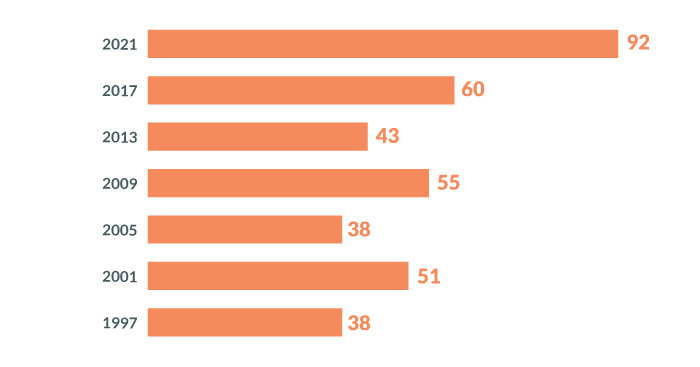
Why run everywhere?
The idea is that by running legislative candidates (even in lopsided districts with little chance of success), a political party can energize tiny pockets of partisans whose votes can lift the party’s candidate at the top of the ticket. The tactic forces incumbent legislators to spend more on their own re-election, leaving them with less money to donate to their party's efforts elsewhere.
Does it work?
There is no definitive answer. In a Governor’s race, there are numerous factors that impact turnout and partisan performance that have nothing to do with whether or not a House race is contested. For instance, turnout could be amped up in a rural county with a particularly heated sheriff's race.
Looking for clues in 15 GOP House districts
With that caveat, VPAP tested the “run everywhere” theory by examining the turnout and partisan performance in 15 solidly Republican House of Delegates districts (listed below) in the 2013 and 2017 gubernatorial elections. In 2013, GOP incumbents ran unopposed in all 15 of these districts. Four years later, Democrats fielded House candidates in 11 of the districts.
Turnout
First, we found that the percentage of voters who showed up to vote was nearly unchanged on average in the 11 districts where Democrats ran a House candidate:
| 4 Uncontested | 11 Contested | Difference | |
|---|---|---|---|
| Average Turnout | 46.78% | 46.88% | 0.10 points |
Party Performance
Second, we looked to see if the presence of a House candidate made any difference in the share of votes received by the two major party candidates for Governor, Democrat Ralph Northam and Republican Ed Gillespie. We found that on average Northam did better (and Gillespie worse) in the 11 House districts where Democrats ran a House candidate:
| 4 Uncontested | 11 Contested | Difference | |
|---|---|---|---|
 Northam Northam |
31.62% | 36.07% | + 4.45 points |
 Gillespie Gillespie |
65.78% | 62.76% | - 3.02 points |
The Bottom Line
It’s a big leap, but here goes: Let’s assume Northam did better in those 11 lopsided GOP districts for one reason and one reason alone - that Democrats ran sacrificial House candidates. Let’s further assume that if those House Democrats had not run, Northam’s performance in those 11 districts would have more closely mirrored what it had been in the four where GOP House candidates ran unopposed.
If you accept all those big assumptions, then the Democrats’ “run everywhere” strategy in 2017 meant a swing of about 21,000 votes in Northam’s favor. (In total, Northam won the election with 233,086 more votes than Gillespie).
| Northam Gained Votes | 12,896 |
| Gillespie Lost Votes | 8,217 |
| Net Democratic Gain | 21,113 |
| in Northam's favor |
Footnote: The 15 solidly Republican House Districts reviewed for this study were House Districts 1, 5, 8, 9, 15, 20, 23, 24, 25, 58, 59, 61, 97, 98 and 99.